
Views: 0 Author: Site Editor Publish Time: 2026-03-17 Origin: Site
Truck-mounted cranes, often referred to as boom trucks, are versatile machines used for a wide range of lifting tasks in industries such as construction, logistics, and energy. Understanding the lifting capacity of these cranes is essential for choosing the right equipment for specific tasks. In this article, we will explore how heavy a boom truck can lift, what factors influence its lifting capacity, and when to use this type of crane for your project.
A boom truck is a type of crane mounted on a truck chassis, featuring a boom (the extendable arm) that enables it to lift and move heavy materials. These cranes are compact, mobile, and designed to perform lighter lifting tasks efficiently. Boom trucks come with either fixed or telescopic booms, which offer different lifting capabilities depending on the task at hand.
What sets boom trucks apart from other cranes is their mobility. Mounted on a truck, these cranes can travel easily from one location to another, providing quick access to job sites and making them ideal for a variety of tasks, especially when speed and flexibility are needed.
Hydraulic Boom: The boom is powered by a hydraulic system that enables lifting, extending, and retracting. The hydraulic system is what provides the lifting power and allows the crane to perform complex movements.
Boom Types: Boom trucks come with fixed booms (non-extending) or telescopic booms (extendable). Telescopic booms offer the flexibility to reach greater heights or distances.
Stabilizers: Boom trucks typically include stabilizers (also known as outriggers) that extend from the truck to the ground, ensuring stability during lifting operations. These stabilizers are critical when handling heavy loads to prevent tipping.
Load Capacity: The lifting capacity of a boom truck typically ranges from 2 tons to 50 tons, depending on the crane’s design, the boom type, and the truck's structural capabilities.
Boom trucks are designed for medium-duty lifting tasks. They typically have a lifting capacity that ranges from 2 tons to 50 tons. However, the actual lifting capacity depends on several factors, including the boom length, hydraulic power, and the crane's design. Larger boom trucks may be able to lift heavier loads, but they are still generally not designed to handle the heaviest lifting tasks required in large construction or industrial projects.
Several factors influence the lifting capacity of a boom truck. Understanding these factors is essential when choosing the right truck-mounted crane for your specific needs.
The length of the boom plays a significant role in determining the lifting capacity. Longer booms allow the crane to reach higher or farther, but this can also reduce the lifting capacity. In general, the longer the boom, the less weight it can lift at the maximum reach. Telescopic booms, which can extend, are designed to offer greater reach, but the lifting capacity is often lower at the extended length.
The hydraulic system is responsible for powering the boom and controlling its movement. A more powerful hydraulic system can provide greater lifting capacity and allow the crane to handle heavier loads. For example, boom trucks with larger hydraulic systems are typically able to lift heavier equipment, even at greater heights.
Stabilizers (or outriggers) are deployed to provide additional support during lifting. They extend horizontally from the crane’s base to distribute the weight of the load evenly. Proper stabilization is crucial when lifting heavy loads, especially in uneven terrain or when working in tight spaces. Properly positioned stabilizers can maximize the crane's lifting capacity, ensuring safe and efficient operation.
The condition of the job site can also affect the lifting capacity of a boom truck. In rough or uneven terrain, the crane may not be able to lift as much weight as it would on level ground. Additionally, site access and space constraints can limit the crane's ability to perform lifting tasks efficiently. Ensuring that the crane has the right stabilizers and setup for the site conditions is essential for maximizing performance.
Boom trucks are typically used for medium-duty lifting tasks. They are best suited for projects that require lifting loads of moderate weight at reasonable heights or distances. Here are some of the most common applications for boom trucks:
In construction, boom trucks are used to lift and transport building materials such as steel beams, bricks, cement bags, and roofing materials. Boom trucks with telescopic booms can reach building heights and provide support for installing large components, but they are usually best for lighter materials and smaller-scale jobs.
Boom trucks are commonly used in logistics and warehousing to load and unload cargo. They can easily lift and place containers, equipment, and supplies in storage or on delivery trucks. Their ability to move freely between locations and perform tasks quickly makes them ideal for logistical operations.
In industries such as manufacturing and energy, boom trucks can be used to move light machinery or equipment around a facility. They are suitable for lifting transformers, pumps, and motors, but not for heavier industrial machinery. Their mobility and flexibility make them ideal for smaller installations and maintenance tasks.
Boom trucks are also used in emergency services for rescue operations, such as clearing debris, lifting heavy objects during disaster recovery, or providing access to high places during search-and-rescue missions. Their compact design allows them to reach disaster sites faster than traditional cranes, making them valuable tools in emergency scenarios.
When choosing the right boom truck for your project, it’s important to consider various factors that can influence its lifting capacity. These factors help determine whether a boom truck is appropriate for your lifting needs.
Fixed Boom: A fixed boom has a single, unchanging length, which makes it less versatile in terms of reach. Fixed booms are typically more stable and have higher lifting capacities when used at lower elevations. However, they are limited in reach compared to telescopic booms.
Telescopic Boom: A telescopic boom extends and retracts, allowing for greater vertical reach and horizontal distance. While they offer more flexibility, the lifting capacity is usually lower when the boom is fully extended. This trade-off must be considered based on the project’s requirements.
The power of the hydraulic system directly impacts the crane’s lifting capability. A more powerful hydraulic system will enable the boom truck to lift heavier loads more efficiently, especially when operating at greater heights.
Proper use of stabilizers is critical for ensuring safe and effective lifting. The stabilizers spread the weight across the truck, ensuring it doesn’t tip over when lifting heavy loads. Their proper deployment and maintenance increase the lifting capacity and overall stability of the crane.
The type of terrain and job site conditions greatly affect the crane’s lifting capacity. Uneven ground or confined spaces may limit the crane's ability to operate at full capacity. Ensuring the site is level and the crane has proper clearance will help maximize performance.
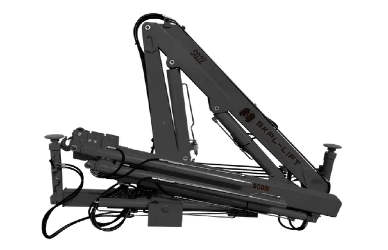
While boom trucks are not designed for the heaviest lifting tasks, they are ideal for projects that require medium-duty lifting and mobility. Here are the scenarios where a boom truck is most effective:
Smaller-scale projects: When lifting light to medium materials or equipment on a construction site.
Logistics: For loading and unloading cargo, moving materials between storage units, or delivering goods.
Tight spaces: Boom trucks are excellent for working in confined spaces where larger cranes cannot access.
Boom trucks are cost-effective, easy to operate, and quick to deploy, making them ideal for projects that don’t require the heavy lifting capabilities of larger cranes.
For heavy-duty lifting tasks, such as handling industrial machinery or lifting loads over 100 tons, boom trucks are not suitable. In these cases, a hydraulic truck crane or crawler crane would be a better fit.
While boom trucks are ideal for medium-duty tasks, they cannot match the lifting power of other crane types. Here’s how a boom truck compares with other common cranes:
Feature | Boom Truck | Boom Crane | Hydraulic Truck Crane |
Lifting Capacity | 2 tons to 50 tons | 10 tons to 100+ tons | 30 tons to 100+ tons |
Reach | Shorter to moderate reach | Extended reach, telescopic boom | Long reach, ideal for high altitudes |
Cost | More affordable | More expensive due to higher capacity | Expensive, especially for larger models |
Mobility | High, truck-mounted, easy to move | Low, stationary or mounted on a platform | Mobile, truck-mounted |
Applications | Material handling, light lifting | Heavy-duty lifting, industrial use | Large construction, energy sector |
No, boom cranes are designed for heavier lifting, typically capable of lifting up to 100 tons or more, while boom trucks are limited to 2-50 tons.
Boom trucks are best for medium-duty tasks. They are not suitable for large-scale projects that require heavy lifting, where a boom crane or hydraulic truck crane would be needed.
The hydraulic system powers the boom, allowing it to extend, lift, and lower loads. The system uses hydraulic fluid to generate force, providing precise control during lifting operations.
While boom trucks are versatile, their performance on uneven terrain is limited. Stabilizers are essential for ensuring stability on such surfaces, but for highly uneven ground, a crawler crane may be more suitable.
Boom trucks provide an excellent solution for medium-duty lifting tasks in industries like construction, logistics, and emergency services. With a lifting capacity of 2 tons to 50 tons, they offer versatility, mobility, and cost-effectiveness. However, their lifting capacity and reach are limited compared to other cranes, making them unsuitable for larger, heavy-duty lifting tasks. For more demanding projects, a boom crane or hydraulic truck crane is a better option.
When deciding whether to use a boom truck, it is important to consider the project's lifting requirements, the job site's conditions, and the type of load. By selecting the right crane, you can ensure efficiency, safety, and cost-effectiveness for your project.


