
Views: 0 Author: Site Editor Publish Time: 2026-01-30 Origin: Site
Selecting the right heavy equipment for a construction or logistics project is rarely a simple apples-to-apples comparison. For project managers and procurement specialists, the confusion often lies in the overlap between equipment classes that seem similar on paper but perform vastly different roles in the field. The distinction between a truck mounted crane and a dedicated mobile crane is the most common point of friction. While both machines are designed to lift heavy loads, they serve fundamentally different logistical purposes. Misidentifying the best tool for the job has immediate financial consequences.
The stakes of this decision are high. Deploying a dedicated mobile crane for a task that requires frequent relocation results in inflated mobilization costs and wasted hours on setup. Conversely, attempting to use a truck mounted crane for a lift that exceeds its stability radius risks safety violations and catastrophic capacity failure. This article compares these units based on mobilization logic, payload versatility, site constraints, and Total Cost of Ownership (TCO), providing a clear framework for your next fleet decision.
The Primary Distinction: Truck mounted cranes (lorry cranes) combine transport and lifting (lift + carry), whereas mobile cranes (all-terrain/rough terrain) are dedicated lifting assets (lift only).
Cost Efficiency: Truck mounted cranes generally offer lower daily rates and eliminate the need for separate transport vehicles due to self-loading capabilities.
Capacity Ceiling: Mobile cranes remain the only option for extreme heights (100m+) and heavy lifts (100t+).
Mobilization: Truck mounted cranes are road-legal highway vehicles; mobile cranes often require permits, escort vehicles, or low-bed transport.
To make an informed choice, we must first clarify the engineering philosophy behind each machine. The industry often uses loose terminology, but the structural differences dictate exactly what each unit can and cannot do on a job site.
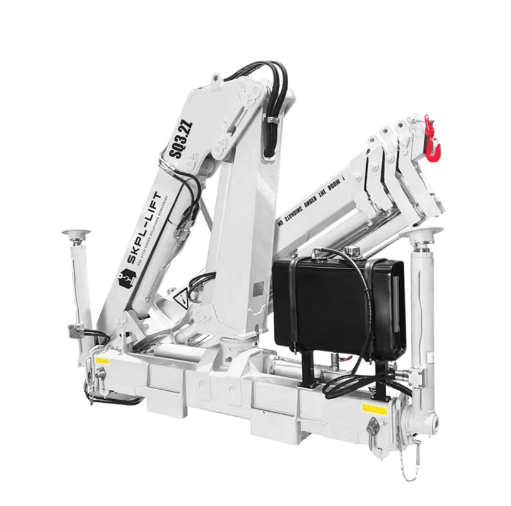
A truck mounted crane—frequently referred to as a lorry crane or boom truck—is essentially a standard commercial truck chassis outfitted with a hydraulic crane. This equipment operates on a "lift and carry" philosophy. The defining feature is not just the boom, but the cargo box or flatbed capability. These units are designed to load equipment at a depot, secure it to their own deck, drive to the site at highway speeds, and offload it independently.
This integration transforms the vehicle into a complete logistics solution. Whether equipped with a stiff telescopic boom or an articulated knuckle boom, the truck mounted crane prioritizes versatility. It serves projects where the goal is moving materials from Point A to Point B and placing them, rather than simply lifting a load that is already present on site.
In contrast, the mobile crane category (encompassing All-Terrain, Rough Terrain, and Crawler cranes) is built around a "pure lift" philosophy. The chassis is not a transport vehicle; it is an engineered mobile foundation designed to support massive counterweights and extreme boom lengths.
The key differentiator here is stability. A mobile crane sacrifices cargo capacity—it has zero payload space—in exchange for raw lifting power. The entire vehicle footprint acts as an anchor. While they can move around a job site, they are not designed to transport materials on public roads. Their primary function is to arrive at a site, establish a static lifting position, and hoist loads that exceed the capacity of logistics vehicles.
It is important to address a common semantic hurdle. Technically, the term "mobile crane" is an umbrella classification that includes any crane capable of moving under its own power, which ostensibly includes truck mounted versions. However, in professional procurement and construction management contexts, "Mobile Crane" specifically refers to dedicated lifting units like All-Terrain (AT) or Rough Terrain (RT) cranes. Industry veterans distinguish them clearly from truck mounted logistics units to avoid the costly mistake of hiring a lifting asset when a transport asset was needed.
Time is often the most expensive commodity on a construction project. Analyzing how quickly equipment can reach the job, set up, and begin working is crucial for maintaining schedule integrity. The mobilization profiles of these two crane types differ significantly.
The truck mounted crane dominates in terms of road legality. Because it is built on a standard commercial chassis, it complies with standard highway regulations. These vehicles can travel at normal highway speeds (65+ mph) alongside regular traffic. For most standard models, there is no requirement for "Wide Load" banners, escort vehicles, or special travel permits. This makes them the ideal rapid-response solution for emergency repairs or just-in-time deliveries.
Conversely, a dedicated mobile crane faces strict logistical hurdles. All-Terrain cranes are often subject to heavy axle load restrictions, requiring special route planning to avoid weight-restricted bridges. They often face speed caps (e.g., 50 mph) and may be restricted from traveling during peak traffic hours. Larger mobile cranes cannot even drive themselves to the site; they must be disassembled and hauled on low-bed trailers, adding a significant layer of logistical complexity and cost.
Operational efficiency on site is defined by the "Park and Lift" capability. Truck mounted cranes excel here. A driver can pull up to the curb, deploy hydraulic outriggers, and be ready to lift within minutes. This rapid deployment makes them perfect for multi-stop days. For example, a utility contractor can drive to five different locations in a single day to install transformers or poles.
Mobile cranes require a formal site establishment process. Because they rely on heavy external counterweights to achieve their lift capacity, setup is labor-intensive. The crew must often position the crane, rig the jib, and stack counterweights—a process that can take hours. This high "mobilization cost" makes them inefficient for short-duration tasks. You would not hire a mobile crane to perform a 30-minute lift if the setup takes two hours.
The trade-off for the truck mounted crane's highway speed is its reliance on improved surfaces. Unless specifically mounted on a specialized 6x6 or 8x8 off-road chassis, these units require paved roads or compacted gravel. They are liable to get stuck in loose mud or soft greenfield sites.
This is where Rough Terrain (RT) and Crawler mobile cranes dominate. They are engineered with oversized tires, crab-steering modes, and high ground clearance specifically to navigate the muddy, uneven chaos of early-stage construction sites. If the ground conditions are poor, the mobile crane is often the only viable option regardless of the load size.
Once the equipment is on site, the decision shifts to technical capability. Project managers must evaluate the physical limits of reach and payload to ensure the lift is feasible and safe.
The most distinct logistical advantage of the truck mounted crane is its self-loading capability. In a traditional workflow using a mobile crane, a manager must rent a flatbed truck to transport the material and a separate crane to unload it. This is the "1+1" cost model.
A truck mounted crane eliminates this redundancy. A single operator can load a generator onto the truck's bed, drive it to the destination, and lift it into place. This consolidation reduces fuel costs, labor wages, and coordination headaches. It effectively cuts the vehicle footprint on site by half, which is critical in congested urban environments.
The type of boom affects access capabilities. Truck mounted cranes frequently utilize knuckle booms (articulated arms). These fold like a finger, allowing the operator to lift loads in tight spaces, such as inside warehouses or underneath bridge decks. They offer precision handling closer to the ground.
Mobile cranes typically utilize telescopic or lattice booms. These are superior for vertical reach and "up-and-over" lifts. If a project involves hoisting steel beams to the top of a 20-story building or lifting over a large obstacle, the geometry of a mobile crane’s boom is necessary. They provide the linear stiffness required for high-altitude precision.
Physics dictates capacity. Truck mounted cranes typically operate in the 3-ton to 100-ton range. However, their capacity drops off significantly as the boom extends horizontally. Because they lack the massive counterweight stack of a dedicated crane, the leverage exerted by a distant load can quickly exceed the truck's stability limit.
Mobile cranes are the heavyweights. With capacities reaching up to 1,200 tons or more, they are the only option for heavy industrial lifts. Their counterweight systems maintain stability even at extended radii. If the load is heavy and must be placed far from the crane's center of rotation, a mobile crane is non-negotiable.
| Feature | Truck Mounted Crane | Mobile Crane (AT/RT) |
|---|---|---|
| Primary Role | Logistics (Transport + Lift) | Construction (Lift Only) |
| Typical Capacity | 1t-120t | 40t – 1,200t+ |
| Boom Type | Knuckle or Telescopic | Telescopic or Lattice |
| Setup Speed | Fast (< 30 mins) | Slow (Hours) |
| Payload | Yes (Cargo Bed) | No (Zero Payload) |
For procurement teams, the decision often comes down to the bottom line. Understanding the Total Cost of Ownership (TCO) or total rental cost requires looking beyond the hourly rate.
Labor is a major component of lifting costs. Truck mounted cranes typically operate on a single-wage model. The driver holding a Commercial Driver's License (CDL) is often also the certified crane operator. This "one man, one machine" efficiency significantly lowers daily operating costs.
Mobile cranes, particularly larger units, require a crew. Union regulations or safety protocols often mandate a separate operator and a rigger/signalman. Furthermore, if the crane requires assembly, a support crew may be needed for setup and teardown. These additional labor layers increase the overhead for every hour the machine is on rent.
Rental structures differ. Mobile crane rental companies usually charge a "min-hours" fee (e.g., minimum 4 or 8 hours) plus an establishment fee to cover the logistics of getting the heavy machine to the site. This makes them expensive for quick lifts.
Truck mounted cranes are more flexible, often operating on a "taxi crane" service model. Because they drive freely like delivery trucks, they can often be booked for shorter durations without punitive establishment fees. For projects requiring scattered, lighter lifts, this pricing model offers superior ROI.
For companies looking to purchase, maintenance is a key factor. A truck mounted crane is mated to a standard commercial truck chassis (e.g., Scania, Volvo, MAN, or generic heavy-duty trucks). The engine, transmission, and drivetrain can be serviced by local truck mechanics using standard parts. This accessibility reduces downtime.
Mobile cranes require specialized heavy equipment technicians. Parts are often proprietary and more expensive. However, when evaluating a truck mounted crane for sale, buyers often find better liquidity and resale value. The versatility of the commercial truck chassis appeals to a broader market of general contractors and logistics companies compared to the niche market for specialized mobile cranes.
To finalize your choice, apply this scenario-based decision matrix to your current project requirements.
Dual Requirement: You need to transport materials and lift them. Examples include delivering generators, HVAC units, K-rail barriers, or building materials.
Multiple Sites: The project involves visiting multiple locations in a single day (e.g., erecting signage across a city).
Good Access: The job site has paved, concrete, or hard-packed dirt access.
Moderate Load: The load is typically under 50 tons, and the reach requirements are within standard limits.
Budget Constraints: You need to minimize mobilization fees and labor costs.
Heavy/High Lifts: The load is exceptionally heavy (100t+) or requires extreme vertical reach (e.g., steel erection for high-rises, tower crane assembly).
Static Duration: The equipment will sit in one location for days or weeks performing repetitive heavy lifting.
Poor Ground Conditions: The site is muddy, has loose soil, or consists of uneven rough terrain where a standard truck would bog down.
Extreme Radius: You need to lift a load over a large building where the horizontal reach demands massive counterweight stability.
No Transport Need: You do not need the crane to carry the load; the load is already on-site or being delivered by separate transport.
Ultimately, the choice between a truck mounted crane and a mobile crane is not just a question of "lifting power" but of "logistical flow." While the mobile crane remains the undisputed king of sheer strength and altitude, the truck mounted crane is the efficiency champion for logistics-heavy operations.
For tasks that require moving cargo and placing it, the truck mounted crane offers a superior ROI by combining two assets into one. For pure construction tasks involving massive structural components or difficult terrain, the mobile crane is the mandatory technical solution. Before booking equipment, we strongly encourage consulting with a lift plan specialist or a reputable truck mounted crane manufacturer to verify load charts. Ensuring your choice matches the load radius and weight is the only way to guarantee a safe and profitable lift.
A: Yes. In most jurisdictions, you need a Commercial Driver's License (CDL) to drive the vehicle on public roads. Additionally, operating the crane mechanism typically requires a specific certification, such as NCCCO (National Commission for the Certification of Crane Operators) in the US, or equivalent local safety licenses. The "one man" model works only if the driver holds both credentials.
A: generally, no. Most mobile cranes are "static" lifters. However, specific "Pick and Carry" cranes (like Franna cranes) exist for this purpose, but they have low capacities compared to stationary lifts. Unlike a truck mounted crane, a standard mobile crane cannot carry a payload on a cargo bed at highway speeds.
A: A mobile crane is typically more expensive. This is due to higher mobilization costs, establishment fees, and the need for a larger crew (operator + rigger). Truck mounted cranes usually have lower hourly rates and eliminate the cost of a separate transport truck, making them cheaper for appropriate tasks.
A: These terms are often used interchangeably. However, "boom truck" often implies a smaller tonnage unit (e.g., 10-20 tons) used for light utility work. "Truck mounted crane" is a broader term that includes massive heavy-duty units (up to 100+ tons) capable of significant construction lifts. Both feature a crane on a commercial chassis.


