Views: 0 Author: Site Editor Publish Time: 2026-07-05 Origin: Site
Equipment failure or improper specification matching creates massive risks for utility fleet managers and contractors. When grid downtime happens, project timelines collapse and severe safety liabilities immediately emerge. Modern utility environments demand highly specialized equipment to handle intense daily workloads. You face high-voltage distribution lines, rugged municipal terrain, and complex telecom infrastructure environments. A standard bucket truck simply cannot handle these intense demands safely or efficiently. Selecting the right platform requires cutting through marketing claims to evaluate raw technical performance. You must rigorously assess dielectric ratings, verify chassis compatibility, and ensure long-term manufacturer support. Fleet equipment decisions dictate operational safety and field efficiency for years. Making the wrong choice jeopardizes personnel and critically delays public infrastructure repairs. Our comprehensive guide details exactly how to navigate this complex equipment landscape. We reveal critical specifications, platform architectures, and safety standards necessary for modern line work. You will learn how to match boom types to grid topologies, verify essential isolation metrics, and assess crucial vehicle integration risks.
Application matching is critical: Telescopic vs. articulating boom choices must align with your specific grid topology and urban clearance restrictions.
Insulation is non-negotiable for live-line work: An insulated aerial platform with verified dielectric testing is mandatory for electrical utility maintenance.
Total Cost of Ownership (TCO) outranks initial price: Factoring in hydraulic reliability, payload capacities, and maintenance intervals prevents costly fleet downtime.
OEM relationships dictate deployment speed: Partnering with a reliable truck mounted aerial work platform oem ensures access to parts, compliance documentation, and custom chassis integration.
Utility maintenance presents entirely different challenges than basic commercial tree trimming or sign installation. Legacy equipment simply falls short during modern grid upgrades. Traditional cranes utilizing suspended baskets introduce severe stability risks. Wire rope suspensions allow dangerous sway during strong winds, jeopardizing technicians working near energized conductors. Basic commercial bucket trucks often lack the structural rigidity required for heavy utility material handling. Complex, multi-point utility projects require purpose-built machinery designed around operator safety and mechanical resilience.
Field success relies heavily on measurable performance criteria. Setup speed directly influences how many outage tickets a crew clears in a single shift. Outriggers must deploy rapidly and secure the vehicle across highly varied terrain. Crews routinely face steep roadside gradients, soft rural berms, and uneven urban curbs. Precise proportional controls represent another critical success factor. Operators demand immediate, exact response from their joysticks to maneuver around complex scaffolding and high-voltage transmission structures safely. Any delay or jerky movement threatens catastrophic electrical contact.
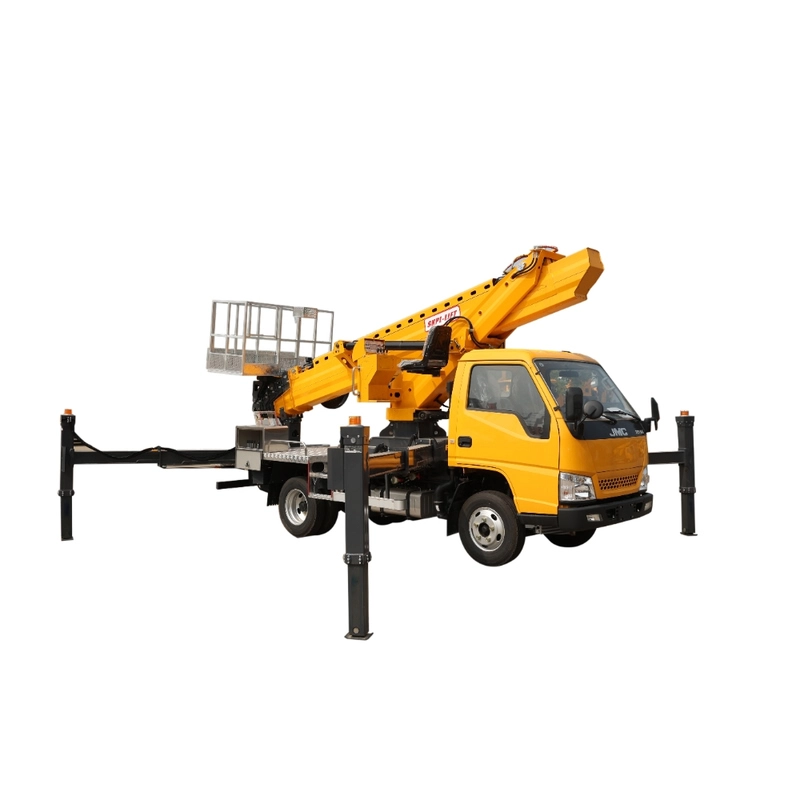
Mobility transforms operational efficiency across widespread service territories. A dedicated truck mounted aerial work platform enables rapid transit between geographically scattered substations or storm-damaged line repair sites. Crews drive the unit at standard highway speeds without coordinating heavy commercial transport trailers. This eliminates secondary logistical delays. You can dispatch a single vehicle directly to emergency outages, deploy the outriggers within minutes, elevate the technicians, and restore power faster. Upgrading your fleet architecture fundamentally improves emergency response times and baseline grid reliability.
Matching the boom design to your predominant operational environment prevents daily workflow friction. Manufacturers generally offer two primary boom architectures: telescopic and articulating. Each excels in distinct utility environments.
Feature Category | Telescopic Boom Platforms | Articulating (Knuckle) Boom Platforms |
|---|---|---|
Primary Strength | Maximum vertical and horizontal reach. | Unmatched up-and-over positioning capabilities. |
Ideal Utility Application | Straightforward access to tall transmission towers and open-sky lines. | Navigating urban telecom webs, thick tree canopies, and substations. |
Mechanical Complexity | Lower complexity, utilizing straight extension cylinders. | Higher complexity due to multiple pivot points and knuckle joints. |
Spatial Footprint | Requires more open space to extend and rotate. | Excels in tight urban alleys and highly restricted clearances. |
Telescopic units push straight outward and upward. They provide maximum vertical reach quickly. When technicians service towering transmission structures in open corridors, telescopic booms deliver unmatched speed. Conversely, articulating knuckle-booms bend at multiple joints. They provide essential up-and-over capabilities. Operators rely on articulating joints to reach over dense urban tree canopies or maneuver around complex substation scaffolding.
Modern operations require a highly responsive hydraulic boom lift to maneuver technicians safely. Outdated hydraulic systems suffer from abrupt stops and sudden pressure surges. Smooth, multi-function hydraulic controls severely reduce operator fatigue during long shifts. More importantly, fluid proportional valves prevent sudden, dangerous cage movements near high-voltage lines. Advanced manifolds allow operators to perform multiple boom functions simultaneously, such as rotating and elevating, without losing hydraulic pressure or experiencing jerky transitions.
Payload configuration demands rigorous evaluation before fleet procurement. Utility workers do not ascend empty-handed. You must evaluate the need for high-capacity baskets capable of safely lifting two heavily geared technicians. The platform must also support heavy utility tools, including replacement transformers, heavy-duty crimping tools, and fiberglass hot sticks. Exceeding structural limits triggers automatic overload sensors, freezing the boom mid-air and delaying the job. Specifying a basket with adequate safety margins ensures crews never compromise safety for efficiency.
Best Practice: Always audit the combined weight of your heaviest two-man crew plus their mandatory PPE, standard toolbelts, and specialized line equipment before defining your minimum payload requirements.
Common Mistake: Purchasing a high-reach platform with a restricted 300-pound basket capacity, forcing crews to utilize secondary lifting mechanisms for materials.
Working near energized infrastructure introduces severe risks requiring specialized hardware. Dielectric isolation separates a standard commercial lift from a true utility-grade asset. An insulated aerial platform guarantees dielectric isolation between the elevated basket and the grounded chassis.
This isolation relies entirely on precision-engineered fiberglass inserts integrated directly into the boom structure. The industry standardizes these insulated booms into distinct ratings. Category A, B, and C ratings dictate the maximum voltage the boom can safely withstand during direct or accidental contact. Operating near 46kV lines requires different fiberglass thicknesses and surface tracking protection than working near standard telecom lines. Procurement teams must mandate regular dielectric testing protocols. ANSI and OSHA regulations strictly require periodic testing to certify the fiberglass remains structurally sound and entirely free from conductive moisture or microscopic carbon tracking.
Stability systems act as the foundational safety layer. Platforms utilize either A-frame or H-frame outrigger configurations. A-frame outriggers angle downward and outward, suitable for lighter units and tight footprints. H-frame (or radial) outriggers extend horizontally before dropping vertically, providing a significantly wider footprint. This wider stance actively supports heavier side-loading when the boom fully extends at a low angle. Smart interlock systems represent a mandatory technological upgrade. These interlocks physically prevent boom operation unless the chassis registers a perfectly leveled state.
Furthermore, equipment must feature redundant emergency systems to guarantee operator retrieval during catastrophic mechanical failures. You must verify these essential fail-safes:
Emergency Descent Valves: Manual bleed valves located at the ground pedestal allow crews to lower the boom using gravity alone if hydraulic pressure vanishes.
Dual-Control Stations: Fully functional override controls located at the truck bed allow ground personnel to seize command of the boom if the basket operator becomes incapacitated.
Backup Power Systems: Independent 12V DC auxiliary pumps provide temporary hydraulic pressure to stow the boom safely if the primary truck engine fails entirely.
Acquiring advanced machinery introduces complex integration variables. Every utility aerial lift must securely pair with a commercial truck chassis. This integration requires precise engineering mathematics. Mismatched gross vehicle weight ratings (GVWR) create immediate legal and mechanical disasters. Mounting a heavy 60-foot articulating boom onto an undersized chassis causes catastrophic suspension failure. It also invites severe regulatory weight violations during DOT inspections. Proper pairing with robust commercial chassis brands—such as Ford, Freightliner, or Kenworth—ensures structural integrity and highway safety.
Maintenance complexity directly impacts fleet uptime. Modern platforms increasingly utilize proprietary software to manage boom functions and safety interlocks. Avoid platforms featuring overly complex, locked-down digital ecosystems. When proprietary software locks in-house fleet mechanics out of basic diagnostics, you lose control over your repair timelines. Opt for equipment offering transparent, easily serviceable hydraulic and electrical schematics. Mechanics need direct access to diagnostic ports and standard override procedures. When internal teams can quickly diagnose a faulty sensor or bypass a damaged limit switch safely, the truck returns to the field within hours instead of waiting weeks for a specialized dealer technician.
Operator adoption involves a distinct learning curve. Transitioning field crews from legacy, lever-actuated equipment to advanced digital proportional controls requires patience and certified training. The tactile feedback differs significantly. Operators must relearn how to feather the joysticks for micro-movements. Factor operator familiarization time into your overall deployment schedule. Mandating comprehensive handover training prevents accidental equipment damage during the first few weeks of deployment.
Best Practice: Involve senior line workers and fleet mechanics during the initial equipment evaluation phase. Their hands-on experience quickly identifies impractical chassis layouts or inaccessible maintenance panels.
Common Mistake: Ignoring axle weight distribution calculations during the upfitting process, resulting in front-axle overloading and severely compromised steering geometry.
Procurement channels heavily influence the final utility of the equipment. Off-the-shelf dealer models rarely meet the specific workflow requirements of a highly specialized utility crew. Direct manufacturer relationships offer distinct engineering advantages. Partnering directly with a reputable truck mounted aerial work platform oem eliminates unnecessary compromises.
Customization transforms a good platform into a perfect fleet asset. Direct dialogue allows utility fleets to specify exact custom tool circuits. Engineers can run auxiliary hydraulic lines inside the boom to power hydraulic tampers, crimpers, or pole saws directly from the basket. You can also specify basket-mounted jib winches for safe material handling at height. Furthermore, direct collaboration allows for bespoke storage body configurations. You can design the utility bed around your specific transformer dimensions, grounding cable reels, and specialized PPE storage needs.
Supply chain volatility constantly threatens deployment schedules. Commercial truck chassis availability remains highly unpredictable. Communicating directly with the manufacturer provides transparent, realistic delivery timelines. OEMs maintain direct allocations with chassis builders. This transparency allows you to plan your fleet retirement schedules accurately while avoiding massive third-party dealer markups.
Aftermarket support defines the ultimate success of the deployment. Evaluate the manufacturer's parts availability and service network rigorously. A robust warranty document provides zero value if the manufacturer cannot quickly ship critical components. When a directional control valve or electronic control module fails at a remote depot, you need overnight replacement capabilities. Direct OEM relationships often guarantee priority access to the factory parts inventory, ensuring your technicians can complete emergency repairs and return the asset to active duty immediately.
Selecting the optimal equipment fundamentally transforms utility maintenance operations. The right choice balances maximum safe vertical reach with rigorous dielectric compliance and daily operational efficiency. Upgrading from legacy bucket trucks to purpose-built utility platforms protects your personnel while significantly accelerating grid repair times. A meticulous evaluation of boom architectures, smart outrigger systems, and chassis weight distribution prevents severe deployment setbacks.
We advise procurement teams to audit their typical job-site heights and calculate required basket payloads rigorously before issuing any Request for Proposal (RFP). Demand documented compliance certificates for all fiberglass inserts and dielectric testing protocols. Never assume an off-the-shelf commercial unit meets high-voltage requirements.
Take proactive control of your fleet modernization strategy. Encourage your fleet directors to demand specific load charts, detailed chassis integration guides, and comprehensive maintenance schematics. Request a direct consultation with the engineering team to map out your specific custom tool circuits and storage needs today.
A: The required rating depends strictly on the line voltage. ANSI A92.2 standards classify insulated platforms into Categories A, B, and C. Category C handles lower distribution voltages, while Categories A and B utilize bare-hand work capabilities for transmission lines. Always verify the specific Category rating matches your highest anticipated grid voltage.
A: Boom lifts drastically reduce setup time and improve personnel safety. Unlike cranes with suspended wire-rope baskets that sway dangerously, specialized boom lifts feature rigid structures, proportional basket controls, and rapid outrigger deployment, allowing technicians to maneuver precisely around energized infrastructure without relying on complex ground-rigging signals.
A: Lead times fluctuate heavily based on commercial truck chassis availability. Standard configurations might take 6 to 9 months, while highly customized utility beds with specific jib winches and Category A insulation can extend up to 12 to 18 months. Direct communication ensures accurate forecasting.
A: Yes, but they require specific factory modifications. Cold-weather packages include internal hydraulic reservoir heaters, synthetic low-temperature fluids, and insulated control modules. Additionally, operators must strictly adhere to the manufacturer's documented maximum wind speed limits, as heavy gusts severely impact the stability of a fully extended boom.