Views: 0 Author: Site Editor Publish Time: 2026-08-12 Origin: Site
Procuring a truck mounted crane represents a major capital expenditure for any organization. Get this decision wrong, and you face severe payload inefficiencies. You also risk serious safety hazards and accelerated chassis wear. You expect these machines to perform a dual role perfectly. They must operate as robust lifting equipment on active job sites. At the same time, they need to function as fully road-legal transit vehicles moving between locations. Balancing these two distinct functions requires careful planning.
This guide delivers a pragmatic, engineering-focused framework to streamline your procurement process. A proper integration ensures maximum efficiency without sacrificing crew safety. You will learn how to accurately evaluate payload capacities based on your daily operations. We will explore different boom configurations to perfectly match your specific site constraints. Finally, you will discover how to integrate the crane and chassis to finalize a reliable vendor shortlist. By following these guidelines, your team can avoid costly integration mistakes.
Procurement hinges on accurately reading a crane’s load chart (capacity vs. working radius), not just its maximum tonnage.
Selecting between a telescopic boom crane and an articulating (knuckle) boom dictates your lifting clearance, suspension limits, and remaining truck payload.
The crane and truck chassis are a system; gross vehicle weight rating (GVWR) and axle distribution must align to ensure legal road compliance and safe lifting stability.
Total Cost of Ownership (TCO) evaluation must include preventative hydraulic maintenance and operator certification requirements.
Many buyers focus entirely on maximum lifting capacity. This narrow focus often leads to poor equipment choices. You must move beyond asking how much it lifts. Instead, determine where and how often it lifts. You must define the exact business problem first. Establish your baseline operational parameters before evaluating any hardware. Consider your typical cargo types and delivery environments. Do your crews lift heavy materials once per week, or do they move pallets hourly? Documenting these operational realities forms the foundation of smart procurement. A well-defined scope prevents you from purchasing an oversized machine. It also ensures you never buy an underpowered unit.
Equipment procurement hinges entirely on understanding the load chart. Maximum tonnage ratings only apply to the shortest possible boom extension. As your boom extends outward, lifting capacity drops significantly. This creates an inverse relationship between lifting capacity and working radius. You must calculate requirements based on your most frequent heavy load. Determine the maximum distance from the vehicle center required to place this load. Once you identify this intersection on the chart, add a safety margin. We highly recommend factoring in a 15-20% safety margin. This buffer protects your equipment from unexpected dynamic loads during adverse weather.
Common Mistake: Relying solely on the headline tonnage number. Buying a 10-ton machine does not mean you can lift 10 tons at a 30-foot radius.
You must evaluate your expected duty cycle frequency accurately. High-cycle logistics applications demand different specifications than low-cycle construction tasks. In urban logistics, crews might load and unload heavy pallets twenty times a day. These repetitive cycles require robust cooling systems for the hydraulic fluid. Conversely, low-cycle applications might involve placing a heavy HVAC unit on a roof once per site. Here, maximum reach and stability matter far more than rapid hydraulic recovery times. Match the equipment durability rating to your specific operational tempo. Overworking a light-duty mechanism leads to catastrophic hydraulic failures.
You cannot ignore deployment realities on the ground. Site topography heavily influences your final equipment choice. Urban logistics often impose severe overhead clearance limitations. Power lines and bridges restrict how high you can elevate your equipment. Open construction sites present different challenges. You must consider outrigger footprint requirements carefully. Soft dirt or uneven terrain demands specific ground bearing pressure calculations. If your outriggers cannot deploy fully, your lifting capacity drops to zero. Always evaluate the physical footprint your machine needs to stabilize itself safely.
You generally choose between two primary structural architectures. These two categories directly impact your operational outcomes. The first category utilizes a stiff, straight boom mechanism. The second category utilizes a folding, jointed mechanism. Each architecture alters the center of gravity and available bed space. We will compare these two solutions to clarify their specific advantages. Making the correct choice ensures your operators can complete tasks efficiently. The wrong choice limits your payload and complicates job site access.
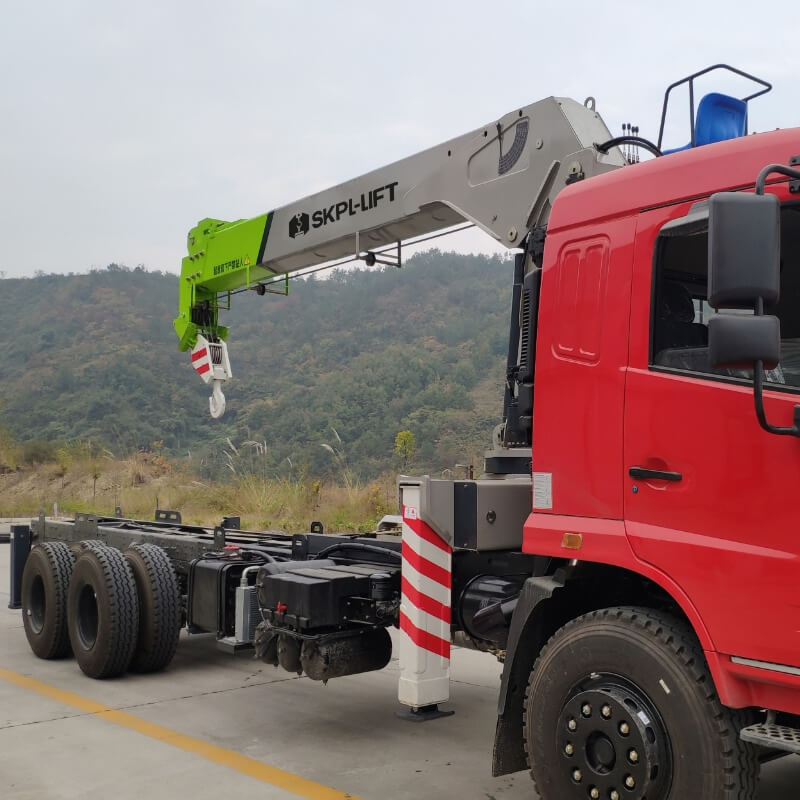
A Telescopic Boom Crane utilizes a straight boom structure. Sections slide inside one another to extend reach linearly. This design excels at deep trench lifting tasks. It also performs brilliantly when placing suspended loads over tall obstacles. You can easily hoist roofing materials or structural steel onto high elevations. The primary advantages include exceptional linear reach and heavy-duty winch capabilities. These machines boast superior height-to-weight lifting ratios. However, they demand significant overhead clearance space. If operators do not exercise strict control, suspended winch lines can pendulum dangerously.
Articulating cranes feature multiple joints similar to a human finger. They fold up compactly when operators finish lifting tasks. This configuration proves ideal for tight urban logistics. It excels at delivering palletized goods in low-clearance environments. The biggest advantage involves spatial efficiency. The entire structure folds compactly behind the cab. This leaves significantly more flatbed space for your actual payload. Articulating mechanisms also offer highly precise close-range placement. The main trade-off is vertical reach. They generally offer lower maximum height for suspended loads compared to stiff boom alternatives.
Operational Feature | Telescopic (Stiff) Boom | Articulating (Knuckle) Boom |
|---|---|---|
Primary Movement | Linear extension via internal cylinders | Folding extension via jointed sections |
Suspended Loads | Excellent via heavy-duty winch lines | Limited, primarily relies on boom hook |
Stowed Footprint | Long footprint, often rests over the bed | Compact, usually folds directly behind cab |
Clearance Needs | Requires high overhead clearance | Functions well in low-clearance areas |
A reliable Truck Mounted Crane acts as a unified system. It is only as capable as the vehicle carrying it. Many organizations fall into a common procurement pitfall. They over-spec the lifting equipment and end up overloading the chassis. You cannot simply bolt heavy lifting equipment onto a standard commercial truck. The two components must integrate flawlessly. The truck frame must endure massive torsional stress during lifts. Engineering alignment between the superstructure and the vehicle dictates long-term success. Treat both components as equal halves of a single tool.
Every commercial vehicle possesses a Gross Vehicle Weight Rating (GVWR). This number dictates the absolute maximum legal weight of the loaded vehicle. You must subtract the dead weight of the lifting equipment from this number. The outriggers, hydraulic fluid, and sub-frame also add substantial dead weight. This combined mass directly subtracts from your legal carrying payload. If your chassis handles 20,000 lbs, installing a 6,000 lb lifting mechanism leaves only 14,000 lbs for cargo. Failing to calculate this deduction accurately leads to constant overloading violations.
Total vehicle weight tells only half the story. You must ensure proper weight distribution across the front and rear axles. Poorly distributed weight causes severe handling issues on the highway. Too much weight on the rear axle lifts the front wheels slightly. This eliminates steerability and creates extreme transit dangers. Too much weight on the front axle destroys suspension components rapidly. You need comprehensive engineering calculations to position the lifting equipment perfectly. Proper placement ensures legal road compliance and guarantees safe lifting stability.
Your chosen truck chassis requires specific structural reinforcements. Standard frames bend under the extreme rotational forces of heavy lifting. You must verify the Resisting Bending Moment (RBM) of the truck frame. The RBM indicates how much stress the steel frame can absorb before permanently deforming. A heavy-duty lifting mechanism requires a chassis with a correspondingly high RBM. Furthermore, you must ensure compatibility with the Power Take-Off (PTO) system. The PTO transfers engine power to drive your hydraulic pumps. Incompatible PTO setups lead to sluggish operations and frequent breakdowns.
Best Practice: Always require your dealer to provide an unladen and laden weight distribution analysis before finalizing the purchase order.
Purchasing the equipment represents just the first step in deployment. You must aggressively address the hidden risks that follow the initial purchase order. Operational downtime creates severe financial penalties on active job sites. You must implement robust risk mitigation strategies early. Anticipate potential mechanical failures before they happen. Create protocols for adverse weather conditions and ground instability. By identifying these implementation risks proactively, you protect your capital investment. A solid risk mitigation plan keeps your equipment working rather than sitting in the repair shop.
You cannot operate heavy machinery without meeting strict regulatory standards. Depending on your region, you must comply with OSHA, ANSI, or equivalent local directives. Modern equipment requires advanced safety technology built into the system. You must specify Load Moment Indicators (LMI) during procurement. These computer systems warn operators before a lift exceeds safe tipping thresholds. Anti-two-block systems are also absolutely critical. They prevent the winch block from colliding with the boom tip. Missing these safety features exposes your company to massive legal liabilities.
Do not assume standard drivers can operate specialized lifting machinery safely. Different boom architectures and tonnage classes require distinct operator certifications. In the United States, operators often need specific NCCCO certifications. Stiff boom operations require different skill sets than knuckle boom operations. You must audit your current workforce capabilities before accepting delivery. Factor training time directly into your deployment schedules. Putting an uncertified operator behind the controls invites catastrophic accidents. Invest heavily in comprehensive safety training to protect your personnel.
Hydraulic systems demand rigorous preventative maintenance to survive harsh environments. You must evaluate the availability of crucial replacement parts locally. Can you easily source hydraulic hoses, cylinders, and PTO components? Relying on overseas shipments for basic parts causes unacceptable downtime. Evaluate the Service Level Agreement (SLA) provided by the manufacturer or regional dealer. Do they offer mobile repair units to fix breakdowns on your job site? Strong preventative maintenance protocols extend the lifespan of your machine significantly.
Inspect hydraulic hoses weekly for micro-abrasions and fluid weeps.
Grease boom extension mechanisms according to strict manufacturer schedules.
Test Load Moment Indicators daily before commencing the first lift.
Verify PTO engagement smoothly without abnormal grinding noises.
You need a structured method to filter manufacturers and localized integrators. Not all vendors provide the same level of engineering competence. Separate the order-takers from the true technical partners. A strong vendor asks probing questions about your daily operational challenges. They should challenge your assumptions if they spot a mismatch in specifications. Evaluate their history of integrating equipment onto your preferred truck brand. Look for vendors who have established, proven relationships with major truck chassis manufacturers.
Prioritize suppliers who provide comprehensive engineering support before the sale. You should never buy equipment based on a simple brochure. Demand detailed 3D weight distribution calculations customized for your exact chassis. Ask for custom integration blueprints prior to purchase. These blueprints should detail exactly where outriggers, sub-frames, and toolboxes will sit. Exceptional engineering support eliminates surprises during the actual build phase. If a vendor refuses to provide these calculations upfront, eliminate them from your shortlist immediately.
Look carefully beyond the basic years listed on a warranty document. A ten-year warranty means nothing if the nearest service center sits 500 miles away. Evaluate the physical proximity of authorized service centers to your primary operating zones. Do they maintain a fleet of mobile repair trucks? Can they dispatch a technician within 24 hours of a breakdown? Real-world support matters far more than theoretical warranty coverage. Rapid access to skilled technicians keeps your operations running profitably.
To receive an accurate and binding quote, you must provide vendors with specific data. Handing them vague requirements guarantees an inaccurate proposal. Prepare a comprehensive data package before requesting pricing. Use the following checklist to gather your baseline metrics:
Maximum Load Weight: Determine the heaviest single item you will ever lift.
Maximum Working Radius: Measure the furthest horizontal distance required to place that maximum load.
Required Truck Payload: Calculate the remaining weight capacity needed for cargo after installing the equipment.
Typical Site Terrain: Describe the ground conditions (paved, mud, uneven) to dictate outrigger specifications.
Overhead Constraints: Note any height restrictions typical in your daily operating environment.
Choosing the correct equipment requires balancing lifting performance with chassis legalities. You cannot optimize for one variable while ignoring the rest. An overpowered lifting mechanism on a weak truck frame invites disaster. A perfectly matched system enhances your daily efficiency and safeguards your operators. Long-term maintenance logistics require just as much attention as maximum tonnage charts.
Always calculate requirements based on your most frequent load at maximum radius.
Account for the dead weight of the installation to maintain legal payload limits.
Prioritize vendors who provide comprehensive 3D weight distribution engineering.
Factor in operator training and preventative maintenance from day one.
Do not finalize your specifications in isolation. Encourage cross-departmental alignment between your fleet manager, site operations lead, and safety officer. We recommend consulting with an engineering sales representative to review your specific operational data. Request a comprehensive payload analysis today to take the next confident step in your procurement journey.
A: Truck mounted cranes utilize standard commercial truck chassis integrated with lifting equipment. This design offers dual functionality, allowing you to lift materials and transport cargo legally on highways. Dedicated mobile cranes are purpose-built strictly for lifting heavy materials. They do not possess flatbeds or cargo capacity for transit delivery.
A: No. Outriggers are virtually always required to maintain the vehicle's center of gravity. Operating without deploying outriggers risks catastrophic tipping and severe structural damage to the chassis. You must deploy and secure them properly regardless of how small the intended load might be.
A: The exact loss varies based on the equipment tonnage and outrigger setup. Typically, the installation subtracts between 2,000 and 10,000+ lbs from your chassis Gross Vehicle Weight Rating (GVWR). You must demand a precise payload deduction calculation from your supplier before purchasing.