Views: 0 Author: Site Editor Publish Time: 2026-08-12 Origin: Site
Specifying heavy equipment requires massive capital investment for commercial fleets. You must get the technical details exactly right. Choosing the wrong boom geometry directly harms job site efficiency. It also limits your payload capacity and complicates daily operations. Fleet managers often face a tough choice between articulating geometry and linear extension models. Each engineering philosophy offers distinct advantages. Making the wrong bet, however, severely limits your daily operational capabilities.
We approach this topic with a skeptical, evidence-based mindset. Neither crane type is universally superior in every scenario. The correct choice depends entirely on a strict evaluation of load charts, deck space constraints, and your specific application environments. You will learn the mechanical differences between these systems. You will also discover how to match crane capabilities to your specific industry demands.
Design: Knuckle boom cranes articulate at 'joints' to fold compactly and navigate obstacles, whereas telescopic cranes use a linear extension system for maximum vertical reach and heavy static lifts.
Payload & Space: Telescopic booms typically require more stowage space over the truck bed, reducing payload height; knuckle booms fold tightly behind the cab, maximizing bed space for hauling.
Operational Precision: Knuckle booms offer pinpoint accuracy for delivering materials directly through tight spaces (e.g., windows), while telescopic cranes excel at dropping loads into deep trenches or hoisting straight up to rooftops via winch systems.
TCO & Maintenance: Telescopic setups offer mechanical simplicity with fewer hydraulic pivot points, often resulting in lower maintenance costs compared to the complex hydraulic arrays of articulating cranes.
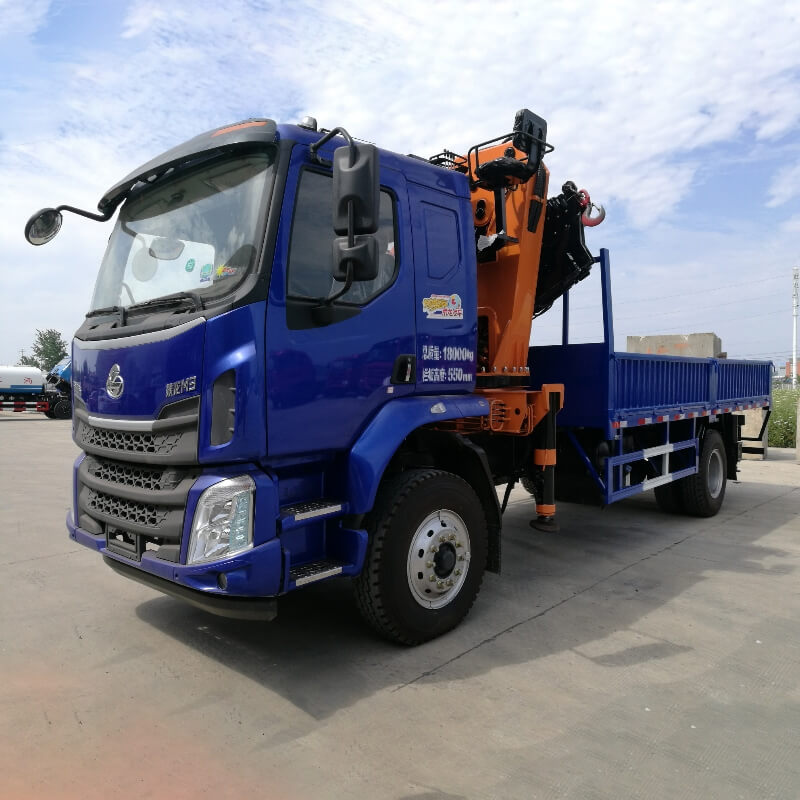
A Knuckle Boom Crane utilizes a multi-segment system. Hydraulic cylinders drive each mechanical joint. This design mirrors a human finger. It bends and folds to reach tricky spots. You will notice the absence of a standard winch system. Instead, operators rely on direct boom movement for payload placement. You can adapt these machines by adding winches later. However, direct attachment remains the standard operating method.
Industry professionals evaluate these machines based on agility. The primary success criteria revolve around maneuvering payloads around physical obstacles. You need it to fold compactly behind the cab. This folding mechanism defines its architectural value. You utilize the vehicle primarily as a transport truck, relying on the boom only during the final delivery phase.
The telescopic Truck Mounted Crane features a straight, rigid boom structure. Internal hydraulic cylinders push linear sections outward. This equipment relies heavily on a heavy-duty winch and cable system. The hook drops down from the boom tip. You do not move the entire boom to adjust the load vertically. You simply spool or unspool the wire rope.
We evaluate these straight boom cranes by their raw lifting capacity. Vertical reach matters most here. The success criteria hinge on maintaining extreme stability during suspended loads. When you hoist an HVAC unit to a three-story roof, you need linear extension. The straight architecture provides superior structural integrity for high-elevation static lifts.
Crane capacities degrade significantly at maximum horizontal extension. Load charts reveal this harsh physical reality. When you push a boom straight out parallel to the ground, gravity multiplies the leverage against the chassis. You lose lifting power rapidly. You must calculate the exact radius of your heaviest typical lift.
Telescopic cranes generally maintain higher lifting capacities at extreme vertical heights. The straight linear structure supports heavier static weights. The load forces travel directly down the rigid boom sections. Articulating booms lose some structural rigidity at extended vertical heights due to their multiple hinge points.
Telescopic models provide "stiff" handling of a winch-suspended load. You drop the cable down precisely into a trench. However, you risk dynamic load swing. Wind easily pushes suspended materials around. An operator must possess high skill to stop a pendulum effect. Weather conditions heavily impact your operational safety window.
Conversely, an articulating boom offers rigid, exact placement. The direct-attachment hook holds materials firmly. This mitigates swing risks in high-wind or tight-clearance environments. You guide the load exactly where it belongs. You can push building materials horizontally through a window frame.
Common Mistake: Operators often attempt to side-pull loads using a telescopic boom. This action stresses the internal wear pads. It can permanently bend the linear cylinders. You must center the boom tip directly over the payload before hoisting.
Consider outrigger deployment requirements. Both setups demand solid footing. However, unfolding an articulating crane requires less overhead operational clearance. You can deploy it under a canopy or inside a large warehouse. It unfurls close to the ground.
Telescopic booms need substantial spatial clearance. You must angle the main boom upward before extending the internal sections. This limits your ability to operate under power lines or tree canopies. You must map out the aerial obstacles before parking the chassis.
Performance Metrics Comparison
Feature | Articulating Boom | Telescopic Boom |
|---|---|---|
Load Suspension | Rigid direct hook | Winch and cable |
Swing Risk | Minimal | High (pendulum effect) |
Overhead Clearance | Low overhead needed | High overhead needed |
Horizontal Reach | Excellent maneuverability | Moderate maneuverability |
Analyze the stowage footprint carefully. An articulating crane folds compactly behind the cab. Sometimes fleet managers mount it at the rear. This configuration leaves the flatbed completely open for cargo. You maximize deck space utilization. You transform the vehicle into a highly efficient transport unit.
Contrast this physical reality with telescopic models. They often stow horizontally over the truck bed. This limits the overall height of hauled materials. You cannot stack pallets as high. The boom rests on a headache rack directly above your cargo. You sacrifice haul volume to gain vertical hoisting reach.
Address implementation realities immediately. The dead weight of the crane significantly affects commercial payload limits. Heavier lifting equipment means less available cargo capacity. You must calculate the chassis limits rigorously.
You must note CDL (Commercial Driver’s License) thresholds. Gross Vehicle Weight Rating (GVWR) regulations dictate fleet staffing. A heavier rig might push a Class 6 truck over the 26,000-pound limit into Class 7 territory. This triggers stricter driver licensing rules. It directly impacts your fleet staffing requirements. You might struggle to find qualified operators for heavier integrated setups.
Highlight the increased number of hydraulic lines on an articulating crane. Count the extra cylinders and pivot pins. More articulation means a higher baseline for preventative maintenance. These mechanical joints represent potential points of failure. You must grease every pin regularly. You must inspect dozens of high-pressure hoses for abrasion.
Maintenance for straight boom models focuses entirely on winch mechanics. Cable integrity requires constant visual checks. Look out for wire fraying or uneven spooling issues. The internal wear pads inside the linear boom sections need regular replacement. You must disassemble the boom entirely to replace these critical friction components.
Best Practice: Always implement a daily pre-shift inspection. Catching a frayed winch cable or a weeping hydraulic fitting early prevents catastrophic job site failures.
Address realistic downtime expectations proactively. Complex hydraulic troubleshooting demands highly specialized technicians. Articulating models might sit longer in the repair shop if a custom joint fails. The diagnostic process takes considerable time.
Straight booms present relative mechanical simplicity. Their lifespan depends heavily on regular cable lubrication and wear pad swaps. Standard heavy equipment mechanics can typically service a linear boom and winch system. You face fewer proprietary multi-valve diagnostic challenges.
You should specify this articulating equipment for distinct applications. Think urban delivery routes. Consider drywall logistics or municipal utility work. The geometry excels when operating around tight street corners and over fences.
Decision Driver: Choose this setup when the truck must act primarily as a heavy hauler. It needs self-unloading capabilities in restricted spaces. You care more about keeping the truck bed fully loaded than reaching maximum heights.
You should specify this linear equipment for heavy industrial tasks. Think commercial roofing or large-scale tree care. Arboriculture demands maximum vertical reach. Heavy machinery rigging and deep utility trenching rely heavily on straight booms.
Decision Driver: Choose this setup when maximum vertical reach matters most. Below-grade hoisting takes precedence over truck bed payload space. You need to drop materials into deep holes smoothly using a winch.
Provide your procurement team with a clear framework. Use these exact steps before finalizing any equipment specifications.
Define your maximum required lift: Check the exact weight of your heaviest load. Determine the maximum horizontal radius required to place it.
Measure your deck space: Calculate the physical dimensions of your typical cargo. Ensure the stowed boom does not crush your vertical stacking limits.
Consult compliance requirements: Review OSHA and ASME B30.5 standards. Verify your operator certification programs align with the specific boom type you select.
Assess your local service network: Ensure you have technicians nearby capable of servicing multi-valve hydraulic systems or heavy-duty winch drums.
The choice between articulating and linear architectures boils down to prioritizing your primary daily tasks. You must choose spatial flexibility and high payload capacity with an articulating setup. Alternatively, you prioritize extreme vertical reach and mechanical simplicity with a straight linear boom.
Do not guess your specifications. Encourage your procurement team to request a detailed load chart analysis. Obtain a comprehensive site audit from a qualified equipment engineer before final procurement. Evaluate your driver licensing constraints and typical cargo volumes thoroughly. Making an informed, evidence-based decision guarantees safer operations and optimized fleet efficiency.
A: OSHA and ASME standards govern operator certification. Certification often depends on maximum lifting capacity (e.g., above 2,000 lbs) rather than just the boom type. However, winch operations on telescopic models require specific training for suspended loads and blind drops.
A: Yes. You can add specialized winches to articulating booms. This bridges the functional gap between the two distinct crane types. However, note the trade-off. Adding a winch increases the dead weight on the boom tip and reduces overall lifting capacity.
A: Articulating models free up significantly more physical volume on the truck bed. They fold up tightly behind the cab. This optimizes the vehicle for transport-heavy applications, allowing you to haul taller and wider cargo.
A: No. Suspended loads on cables behave dangerously in high winds. You face severe load-swing risks. Articulating booms use rigid, direct attachments that hold materials firmly. This rigid connection offers much better control during adverse weather conditions.