Views: 0 Author: Site Editor Publish Time: 2026-06-12 Origin: Site
Misaligning forestry equipment causes severe operational bottlenecks. You might experience prolonged loading times. Site managers often struggle to keep operations fluid. Both machines move wood effectively. However, their structural designs dictate entirely different workflows on the ground. Choosing between these machines requires careful evaluation. You must assess landing size, transport logistics, and daily volume targets. We built this guide to help you decide.
We provide a clear, evidence-based evaluation framework. Fleet managers face unique logistical challenges daily. Independent logging contractors also navigate complex site conditions. This article helps you select the right asset for your specific operational scale. You will learn the engineering differences driving these machines. We also explore performance metrics and terrain adaptability. Ultimately, you will match the perfect equipment to your precise site requirements.
Primary Distinction: A timber crane prioritizes mobility and multi-role transport (often truck-mounted), whereas a log loader is a dedicated, high-capacity machine built for continuous sorting and loading at a stationary landing or yard.
Volume vs. Agility: Log loaders offer superior hydraulic power and continuous swing cycles for high-yield operations; timber cranes eliminate the need for a secondary loading machine on smaller or scattered tracts.
Cost Implications: Timber cranes generally present a lower barrier to entry and reduced transport costs, while log loaders require a higher initial capital expenditure (CapEx) but deliver lower cost-per-ton in high-production environments.
Understanding structural designs helps you align equipment capabilities to your daily workflow. Engineers build each machine for distinct operational environments. They prioritize different functions during the design phase.
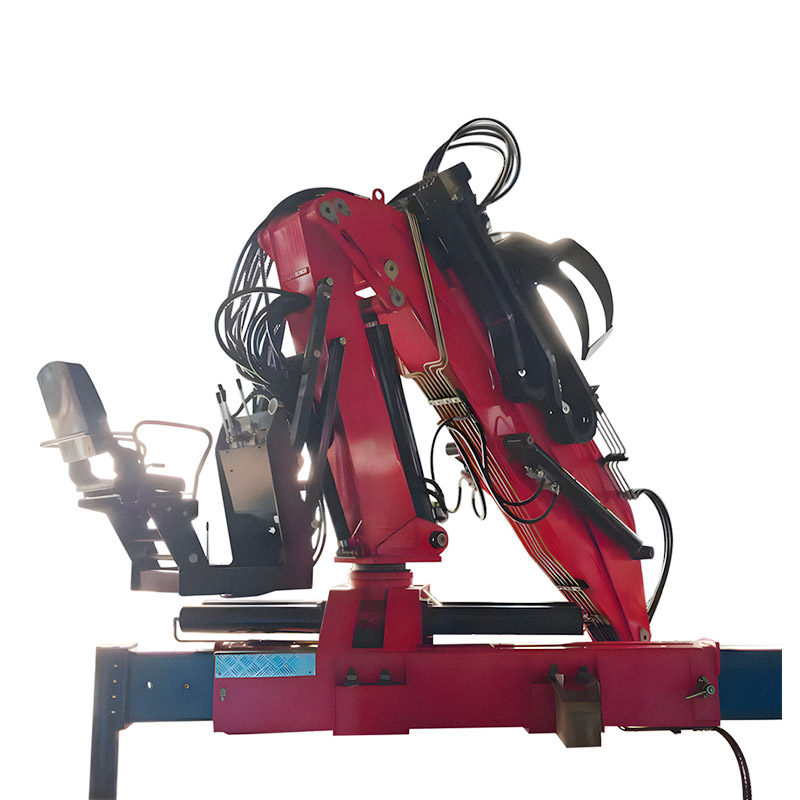
A Timber Crane functions as an articulated hydraulic arm. Operators typically mount it on a log truck, forwarder, or trailer. The design focuses heavily on compact folding capability. It provides precise grapple control. It also ensures immediate integration onto transport vehicles.
This design offers immense flexibility. However, it presents specific limitations. The reach radius remains limited compared to heavy-duty alternatives. It heavily relies on the stability of its mounting vehicle. Overloading the grapple can destabilize the entire truck. Operators must carefully balance loads during operation.
A log loader functions as standalone heavy machinery. Manufacturers often base them on excavator chassis. They also build purpose-built wheeled handlers. These machines exist exclusively to manipulate timber.
The design focuses on maximum visibility and stability. Elevated cabs give operators clear sightlines across busy landings. Heavy-duty undercarriages provide immense ground stability. High-flow hydraulics ensure rapid, continuous cycle times. They handle massive payloads effortlessly.
These advantages come alongside distinct limitations. These machines require specialized transport. You must use lowboy trailers to move them between job sites. They also carry a larger footprint and consume more fuel daily.
Feature | Timber Crane | Log Loader |
|---|---|---|
Mobility | Self-driving via truck chassis | Requires heavy-haul trailer transport |
Hydraulic Flow | Moderate, optimized for precision | High-flow, optimized for continuous speed |
Base Stability | Relies on truck outriggers | Relies on heavy tracked/wheeled undercarriage |
Primary Role | Loading/unloading transport vehicles | Sorting, staging, and continuous loading |
Performance metrics dictate how efficiently a machine clears a landing. You must measure lift capacity alongside cycle speed. Operator comfort also directly impacts daily output.
You must carefully assess hydraulic lifting charts before deploying equipment. Log loaders dominate in handling oversized timber. They easily manage dense hardwoods. They excel at multi-stem grabs. Their hydraulic systems sustain heavy loads across maximum extensions.
Crane lifting capacity drops significantly at maximum extension. Operators must position the truck closer to the timber. They function best for single-stem loading. They also excel at handling processed cut-to-length (CTL) logs. Pushing beyond these limits risks hydraulic failure.
Log loaders feature continuous 360-degree rotation. They utilize faster boom cycles. These features prove critical for sorting multiple species. They also sort various log grades efficiently at busy landings. Operators maintain a steady rhythm without repositioning the base.
Cranes utilize slower cycle times. They have limited swing arcs. This makes them highly efficient for self-loading tasks. However, it renders them inefficient for primary yard sorting. Attempting to sort an entire landing using a knuckleboom wastes valuable daylight.
High-production environments strongly favor dedicated loaders. Manufacturers isolate these cabs from engine vibration. Elevated lines of sight reduce operator strain. Fatigue plummets over a 10-hour shift. Comfortable operators maintain consistent safety standards and higher output.
Pre-Sort Timber: Skidders should drop logs in organized piles.
Maintain Swing Clearances: Keep the immediate radius free of debris.
Optimize Grapple Size: Match the grapple precisely to the average stem diameter.
Limit Boom Extension: Position the machine to avoid reaching maximum stretch continually.
Your equipment must match the physical realities of your job site. Terrain dictates machinery choices. Site logistics often present complex challenges.
Truck-mounted arms excel in selective logging scenarios. They perform beautifully during right-of-way clearing. They also dominate residential operations. Bringing a tracked machine into these areas proves structurally unfeasible. Compact articulation allows operators to navigate around standing trees easily.
Tracked heavy machinery requires established landing zones. These zones must remain relatively flat. Operators need ample swing clearance to function safely. Preparing these sites demands extra time from bulldozers or excavators.
Wheeled variations require stable ground. They perform best in millyards. Compacted ground prevents deep rutting. Soft soil bogs down wheeled equipment quickly. You must assess soil composition before deploying wheeled loaders.
Mobility changes everything for independent contractors. A truck-mounted arm drives itself directly to the site. The operator finishes a job and immediately drives to the next location. This seamless transition saves entire workdays.
Dedicated heavy equipment requires DOT-compliant heavy haul transport. You must schedule a lowboy trailer. You need specialized drivers. This mobilization adds significant logistical complexity per move. Frequent relocations destroy efficiency.
Measure Landing Dimensions: Ensure adequate swing radius for heavy machinery.
Analyze Soil Stability: Identify soft zones prone to deep rutting.
Map Access Roads: Confirm lowboy trailers can safely navigate access routes.
Calculate Relocation Frequency: Determine how often equipment moves between tracts weekly.
Machinery requires continuous upkeep to remain functional. Structural designs introduce specific maintenance vulnerabilities. Understanding these factors prevents unexpected downtime.
Truck-mounted arms feature exposed hydraulic lines. Articulation creates natural friction points. Hoses rub and degrade over time. Loading stresses also transfer directly to the truck chassis. Over time, operators notice wear on the truck suspension. Frames experience metal fatigue.
Heavy standalone machines face different challenges. Undercarriage wear remains a constant issue. Tracks and rollers degrade quickly in abrasive terrain. Rocks and mud grind down metal components. Operators also face complex swing motor maintenance. Servicing these components requires specialized mechanical knowledge.
Equipment sitting idle drains operational efficiency. A heavy machine waiting for low timber volume disrupts workflow. It must operate continuously to justify its presence. You cannot afford idle heavy machinery on small tracts.
Truck-mounted arms offer exceptional utilization for independent owner-operators. They combine hauling and loading phases into one single asset. The operator loads the timber, secures it, and drives away. The machine never sits idle waiting for trucks. It constantly contributes to the daily output.
Ignoring daily grease point schedules on articulated joints.
Failing to clear packed mud from undercarriage rollers.
Operating hydraulic systems before the fluid reaches proper working temperature.
Overlooking micro-fractures on truck mounting brackets.
Selecting the right asset requires comparing site realities against equipment capabilities. You must objectively evaluate your daily workflow. Let us explore two common operational scenarios.
We recommend a dedicated Log Loader for this scenario. High-volume operations demand relentless pacing. You must keep pace with multiple skidders. Feller bunchers drop timber rapidly. Continuous truck loading remains mandatory. Only a dedicated, high-flow hydraulic machine handles this intense rhythm.
We recommend the articulated arm approach here. This setup eliminates heavy haul transport logistics. It provides sufficient capacity for processed logs. It maximizes mobility between low-yield sites. You transition between scattered tracts seamlessly.
Integrating adaptable solutions into your fleet prevents workflow bottlenecks. Matching the asset to the environment ensures smooth daily operations.
Operational Factor | Favors Timber Crane | Favors Log Loader |
|---|---|---|
Daily Tonnage Targets | Low to Moderate (< 10 loads/day) | High to Extreme (Continuous loads) |
Equipment Relocation | Frequent (Daily/Weekly moves) | Rare (Stationary for weeks/months) |
Staffing Availability | CDL Drivers available | Heavy Equipment Operators available |
Road Transport Limits | Strict local weight restrictions | Open heavy-haul access permitted |
The choice between these two machines rarely involves determining an objective winner. Instead, you must identify your primary operational bottleneck. If mobility and self-sufficiency limit your progress, the truck-mounted arm wins. It navigates tight spaces and self-transports effortlessly. Conversely, if sorting speed and continuous duty dictate your success, the dedicated loader remains strictly mandatory.
Take immediate action by auditing your site-to-site transport logistics. Track your daily idle times carefully across a standard operational week. Identify exactly where your workflow slows down. Finally, consult regional equipment dealers. Request an efficiency analysis based on your specific fleet configuration before acquiring new machinery.
A: Yes, but it operates inefficiently in this role. They lack the rapid cycle times required for heavy sorting. They also lack the extensive reach and grounded stability of a dedicated machine. This leads to significantly longer sorting times and higher operator fatigue.
A: Tracked models generally boast a longer structural lifespan. They often exceed 15,000 hours with proper maintenance. Engineers design their heavy-duty frames specifically for continuous abuse. Articulated arms often face mounting point stress and metal fatigue sooner. Lifespan heavily depends on daily payload abuse.
A: Operating the equipment on private land typically does not require a special license. However, driving a truck-mounted model on public roads requires an appropriate Commercial Driver’s License (CDL). Transporting heavy machinery via lowboy trailers also demands adherence to strict local DOT regulations.
A: Yes, absolutely. Trailer-mounted and tractor-mounted forestry arms remain highly popular. Smaller-scale operations and farm forestry sectors utilize them frequently. They offer a highly modular and versatile alternative to massive commercial equipment, adapting easily to various agricultural vehicles.