
Views: 0 Author: Site Editor Publish Time: 2026-03-16 Origin: Site
When it comes to lifting heavy loads and handling materials in construction, logistics, or other industries, cranes play a vital role. Two popular types of cranes commonly used are boom cranes and boom trucks. Although they share similar names and operate under the same basic principles, there are significant differences between the two, especially when it comes to mobility, lifting capacity, and applications. This article will explore the differences between a boom crane and a boom truck, helping you understand which equipment is most suitable for your specific needs.
A boom crane is a type of crane that utilizes a long, extendable arm (known as the boom) to lift and move heavy materials or equipment. The boom may be fixed or telescopic (extendable) depending on the model, offering a variety of lifting capabilities. Boom cranes are designed to be stationary, typically mounted on a larger structure, like a fixed base or a mobile platform such as a construction vehicle.
Hydraulic System: Most boom cranes operate using a hydraulic system that allows for smooth and precise lifting. This system utilizes hydraulic cylinders to control the movement of the boom, allowing it to extend, retract, and rotate.
Boom Design: Boom cranes come with either a fixed boom or telescopic boom:
Fixed Boom: The boom has a fixed length and offers reliable strength for lifting tasks.
Telescopic Boom: The boom can extend and retract, providing greater reach and height for lifting.
Load Capacity: Boom cranes generally have higher lifting capacities, often ranging from 10 tons to over 100 tons depending on the model. This makes them suitable for heavy-duty tasks in industrial construction, energy, and heavy machinery lifting.
Stability: Boom cranes often come with stabilizers (or outriggers) that extend to the ground for added stability during operation, ensuring the crane doesn’t tip over while lifting heavy loads.
Boom cranes are typically used for large-scale and heavy-duty lifting tasks in a variety of industries:
Construction: Lifting heavy materials such as steel beams, concrete, and other building components.
Energy: Lifting and installing heavy equipment like transformers, generators, and turbines at power plants or substations.
Manufacturing: Handling large industrial machines or equipment that require precise placement.
Shipping and Logistics: Loading and unloading heavy containers and machinery at ports or warehouses.
Boom cranes are designed to handle challenging lifting tasks that require a high load capacity and long reach, making them a preferred choice for large-scale operations.
A boom truck, also known as a truck-mounted crane, is a type of crane that is mounted on the back of a truck chassis. The crane is equipped with a boom that can either be fixed or telescopic, allowing it to lift and move materials. Unlike boom cranes, which are often stationary or mounted on larger platforms, boom trucks are highly mobile and can travel between job sites with ease.
Fixed or Telescopic Boom: Most boom trucks come with either a fixed or extendable boom. The fixed boom typically offers shorter reach, while a telescopic boom provides the flexibility to extend and reach greater heights.
Hydraulic System: Like boom cranes, boom trucks also utilize a hydraulic system for lifting, providing smooth and efficient operation. However, the lifting capacity is typically lower than that of larger boom cranes.
Mobility: The standout feature of a boom truck is its mobility. Mounted on a truck chassis, boom trucks can be driven directly to a job site without requiring extra transportation.
Load Capacity: The load capacity of boom trucks typically ranges from 2 tons to 50 tons, depending on the model. While they are not designed for ultra-heavy lifting, they are capable of handling medium-duty lifting tasks.
Boom trucks are more commonly used for smaller-scale operations and in situations where mobility is key. Common applications include:
Construction: Lifting materials and equipment on small to medium-sized construction sites.
Logistics and Warehousing: Loading and unloading cargo from trucks, placing equipment or supplies in warehouses, or moving materials around a site.
Transportation: Moving smaller pieces of equipment or cargo that require quick transport and easy access.
Boom trucks are ideal for lighter jobs, where the task’s scale and lifting requirements don’t call for a massive crane. Their mobility makes them perfect for rapid deployments and smaller lifting tasks.
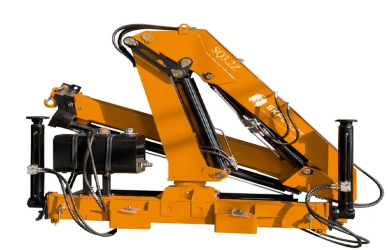
While boom cranes and boom trucks share similar features, they have key differences that make them suited for different applications. Below is a breakdown of their core differences:
Feature | Boom Crane | Boom Truck |
Mobility | Stationary, or mounted on large platforms | Mobile, mounted on a truck chassis |
Load Capacity | 10 tons to 100+ tons | 2 tons to 50 tons |
Boom Design | Telescopic or fixed boom | Fixed or telescopic boom |
Cost | Higher operating and maintenance costs | More cost-effective and budget-friendly |
Reach and Height | Long reach, high lifting height | Shorter reach compared to boom cranes |
Applications | Large-scale construction, industrial lifting | Small to medium construction, logistics, and material handling |
Stability | Requires stabilizers for stability | Some models come with stabilizers, but may not be as stable as boom cranes |
Boom Crane: Boom cranes are stationary and typically installed on large platforms, such as on construction sites or heavy-duty machinery. While they can be mounted on mobile platforms, their primary function is lifting heavy loads at a fixed location.
Boom Truck: Boom trucks are mounted on a truck chassis, making them mobile and able to be easily driven between job sites. This is a significant advantage when rapid deployment and mobility are essential.
Boom Crane: Boom cranes are built for heavy lifting, with capacities ranging from 10 tons to over 100 tons. This makes them ideal for large-scale projects that require lifting heavy equipment and materials.
Boom Truck: Boom trucks are more suitable for lighter loads, typically ranging from 2 tons to 50 tons. They are not designed for the same heavy-duty tasks as boom cranes but can handle medium-sized lifting tasks effectively.
Boom Crane: Due to their high lifting capacities and complex hydraulic systems, boom cranes are more expensive to purchase, operate, and maintain.
Boom Truck: Boom trucks are more affordable due to their simpler design and lower lifting capacities. They are ideal for businesses or projects with budget constraints.
Choosing between a boom crane and a boom truck depends on the specific requirements of your project. Consider the following factors when making your decision:
If your project requires heavy-duty lifting with high load capacities (e.g., lifting heavy industrial equipment or construction materials), a boom crane is your best option. If the task involves lighter materials or requires mobility, a boom truck may be more suitable.
If your job site requires quick movement between different locations, a boom truck is a more suitable choice due to its mobility. On the other hand, if you’re working in one location and need a heavy-duty crane to handle large-scale lifting tasks, a boom crane is the ideal choice.
If you’re working with a limited budget, a boom truck may be a more cost-effective option. It is less expensive to purchase and operate compared to a boom crane, making it ideal for smaller projects or businesses with budget limitations.
If your job site has limited access or is in a confined space, a boom truck may be a better option due to its compact design and ability to work in tight spaces. For large, open sites where high lifting capacity is required, a boom crane would be the preferred choice.
Boom trucks typically have a lifting capacity of 2 tons to 50 tons, which makes them ideal for medium-duty tasks in construction, logistics, and material handling.
Yes, boom cranes are typically more expensive due to their higher lifting capacities and advanced hydraulic systems.
Boom trucks are best suited for small to medium-scale projects. For large-scale construction or projects involving heavy equipment, a boom crane would be a better fit.
Boom trucks are ideal for confined spaces due to their compact design and quick setup time, making them more suitable for projects where space is limited.
While both boom cranes and boom trucks serve the same basic purpose—lifting and moving materials—there are key differences in their mobility, load capacity, cost, and applications. A boom crane is best suited for large-scale construction and industrial lifting, offering high lifting capacity and extended reach, while a boom truck is ideal for smaller, lighter tasks where mobility and cost-efficiency are essential.
When choosing between the two, it’s important to assess your project’s specific needs, including load requirements, budget, and site conditions. Both types of cranes are valuable tools, and selecting the right one will ensure that your project is completed safely, efficiently, and within budget.


